



History Projects
Fact-checked stories from Polish history, each with a short summary and the podcasts, images and videos.

Podcasts, images and videos coming soon
Battle of Monte Cassino Cinematic Video
Cinematic Video for 8-years old
Breaking of the Enigma code by Polish mathematicians
Marian Rejewski, Henryk Zygalski, and Jerzy Różycki successfully reconstructed the German Enigma machine using mathematical analysis and limited intelligence from a French source. A month before Hitler attacked Poland in September 1939, the Poles gave working replicas of Germany’s Enigma machine and operating instructions to stunned British and French counterparts, who had struggled for years to understand and break Enigma without success. This technology transfer enabled the British to establish their own Enigma program and build a large electro-mechanical apparatus that was able to decrypt German communications. Cracking the Enigma code proved to be vital in World War II and contributed to the Allies’ ultimate victory.
Deliverables
Podcasts, images and videos coming soon
Hans von Kulmbach and His Works for Krakow
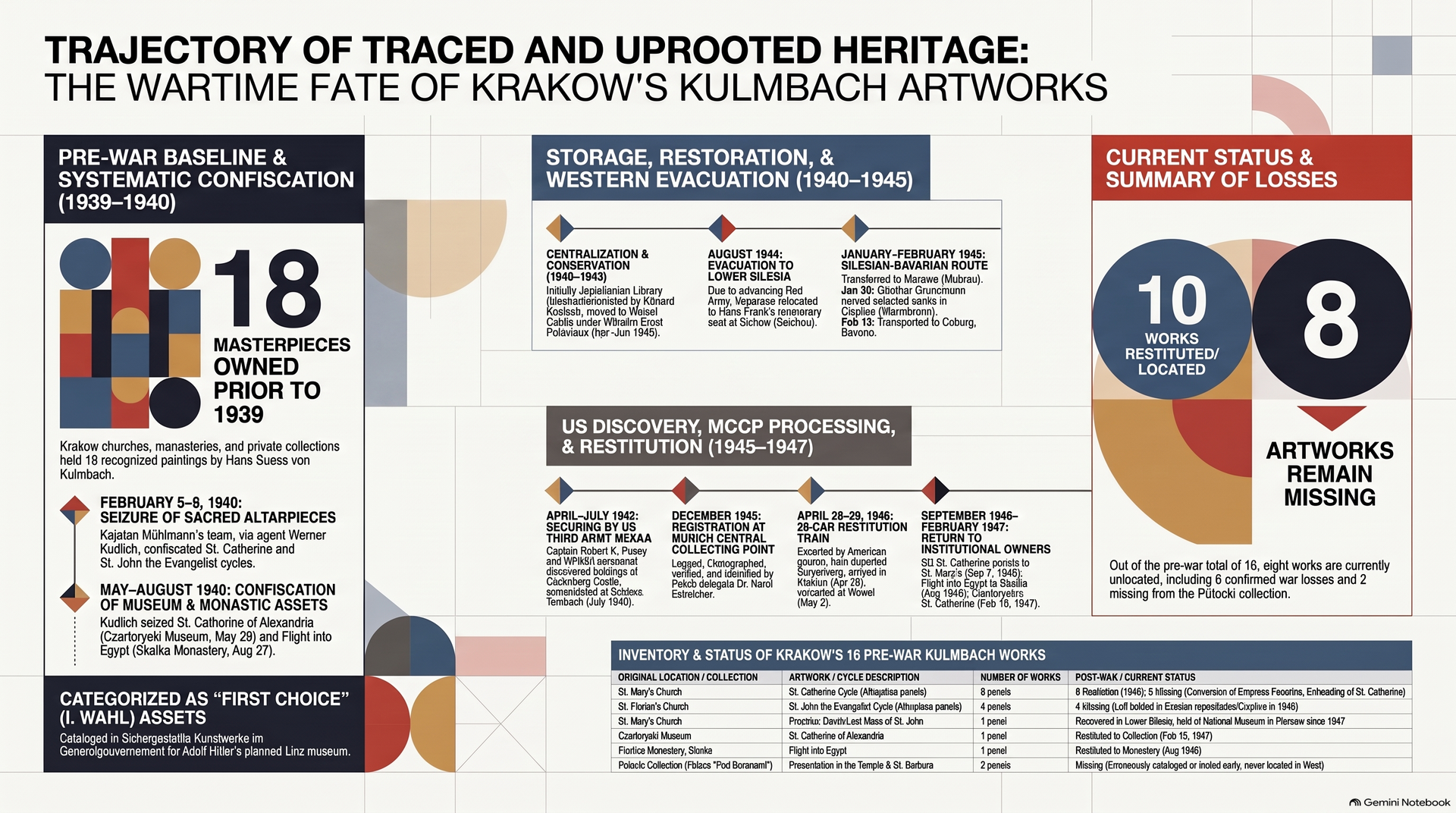
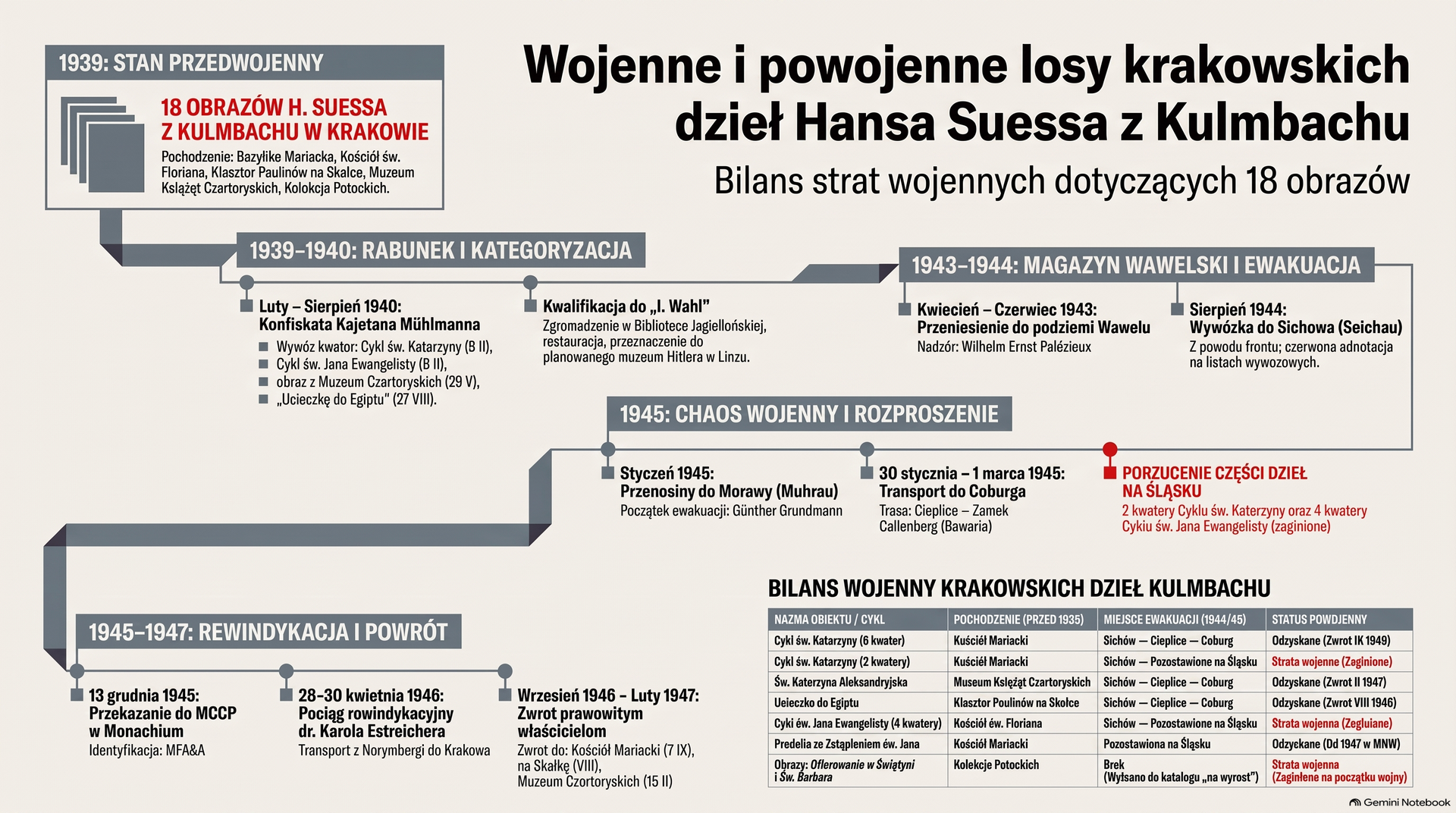
The provided sources examine the wartime and postwar journeys of cultural artifacts in Kraków, focusing particularly on the looted masterpieces by the German Renaissance painter Hans Suess von Kulmbach. Following the Nazi occupation of Poland, specialized units systematically confiscated religious paintings, altarpieces, and museum collections to serve Nazi propaganda and ideological dominance. While some items were hidden or rescued, many artworks—including panels from the St. Catherine altarpiece and the St. John the Evangelist series—were seized, cataloged, and eventually evacuated to Silesia as the eastern front approached. Ultimately, the text highlights the devastating wartime losses of these sacred works, the methods used by the occupation forces to document and conserve them, and their complex paths toward restitution in the postwar era.
Deliverables
Hans von Kulmbach Infographic - EN
Hans von Kulmbach Infographic - PL
Hans von Kulmbach Cinematic Video - EN
Hans von Kulmbach Cinematic Video - PL
Hans von Kulmbach Slide Deck - EN
Hans von Kulmbach Slide Deck - PL
Hans von Kulmbach Audio Podcast - EN
Hans von Kulmbach Audio Podcast - PL
Polish Scouts fight against the Germans
During Germany’s occupation of Poland, the Polish Scouts went underground and became a paramilitary organization called the Grey Ranks (Polish: Szare Szeregi). Boy Scouts over seventeen carried out sabotage, armed resistance, and assassinations. The Girl Scouts, called Girl Guides, formed support units working as nurses, messengers, and letter and munition carriers. The youngest Boy Scouts carried out small sabotage operations such as dropping leaflets and painting the Kotwica sign on the walls. The Kotwica sign was designed by Girl Guide Anna Smoleńska. During the Warsaw Uprising, the scouts participated in the fighting, and several Szare Szeregi units were some of the most effective in combat.
Deliverables
Podcasts, images and videos coming soon
The Battle of Monte Cassino
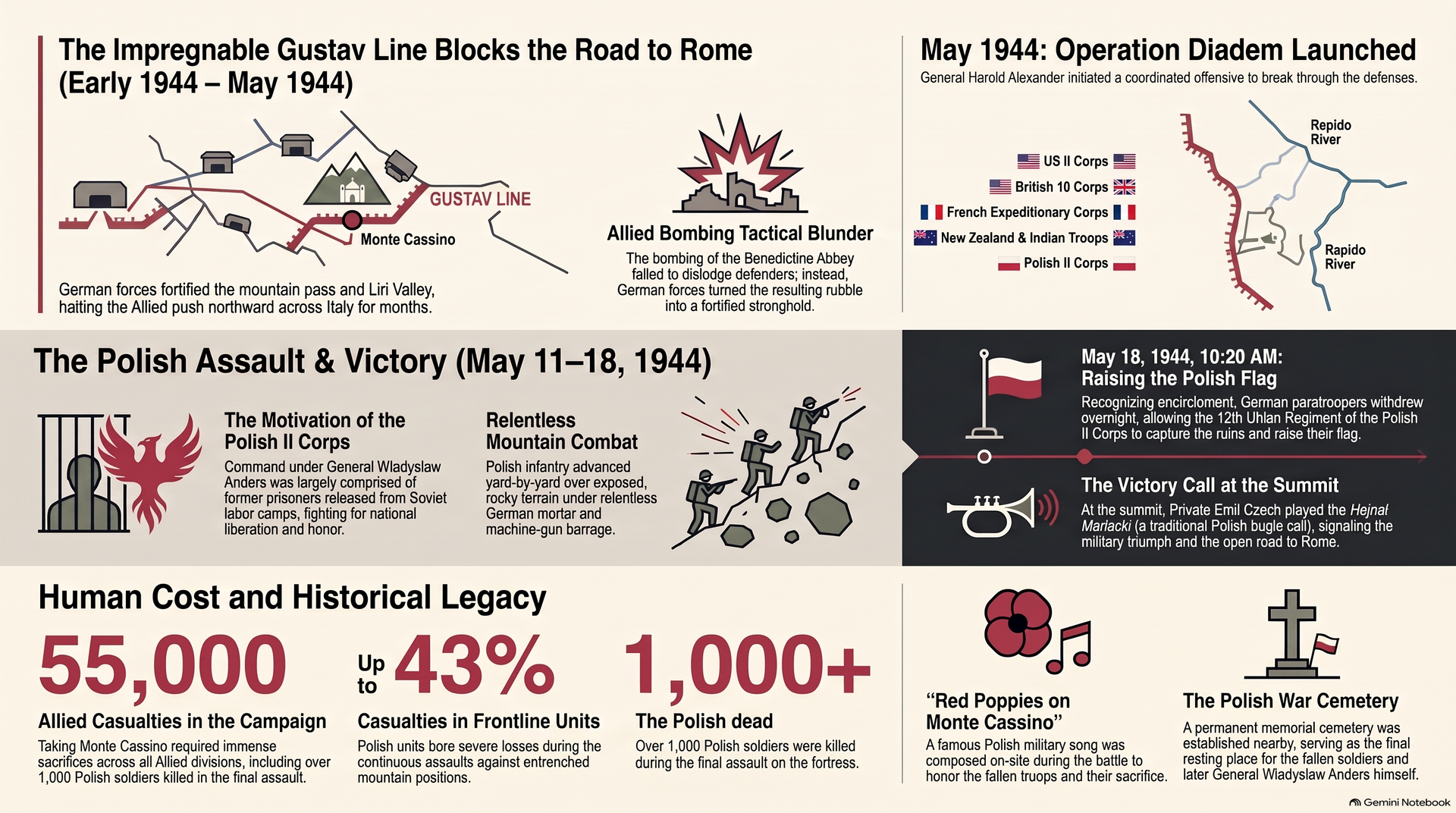
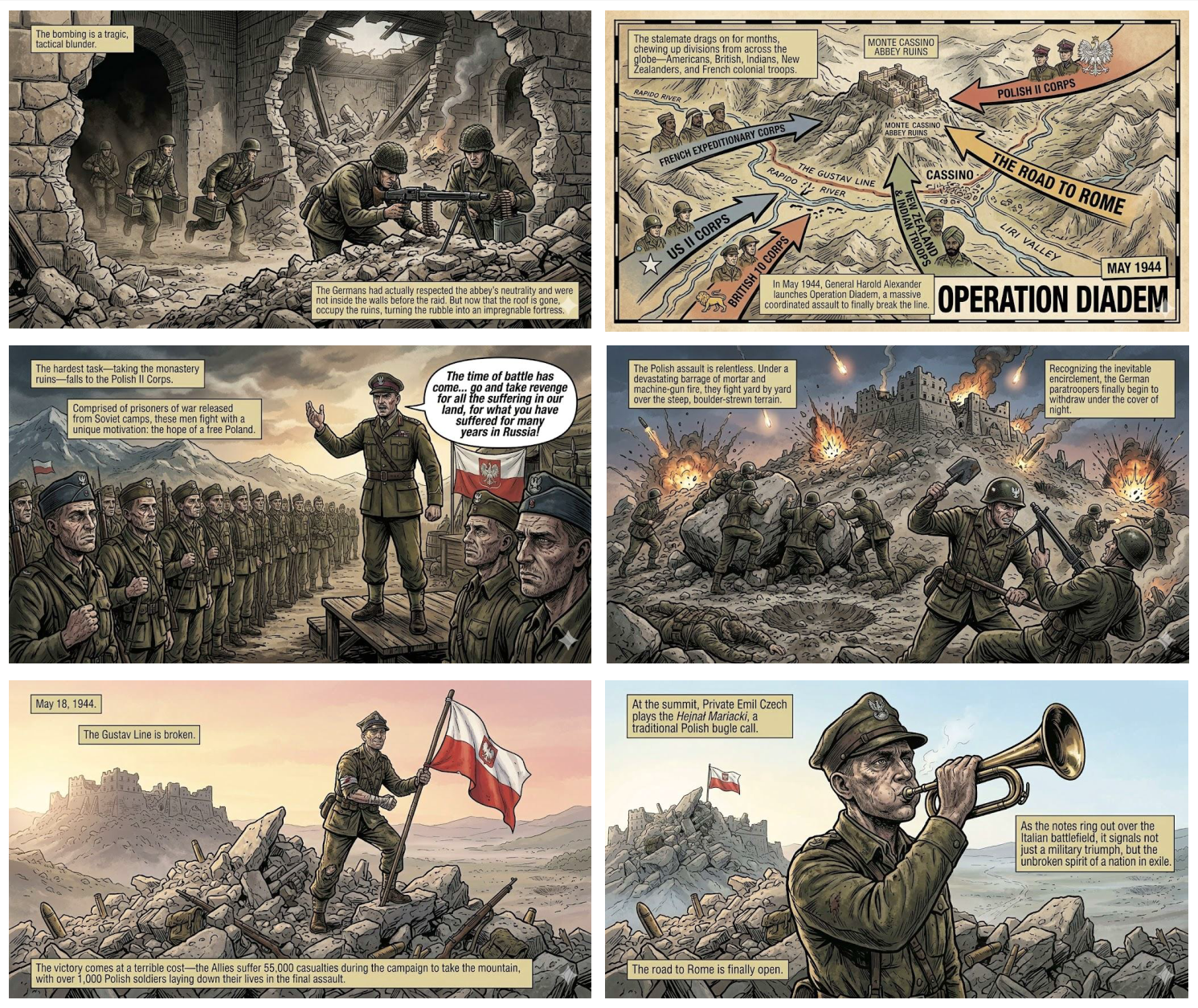
The Battle of Monte Cassino was one of the most important battles of World War II in Europe and lasted four months in early 1944. There were four assaults by the Allies and in the final assault, the Polish 2nd Corps took the monastery atop a summit, which the Germans used as their defensive position to stop the Allied advance through the Liri Valley. As the Germans withdrew, Hitler’s Gustav Line was broken, and the Allies advanced to Rome. General Władysław Anders and the Polish 2nd Corps went on to liberate the Italian cities of Loreto, Ancona, Faenza, and Bologna.
Deliverables
Battle of Monte Cassino Infographics
Battle of Monte Cassino Sketches
Battle of Monte Cassino Cinematic Video
Battle of Monte Cassino English Podcast
Tytuł odcinka Polish Podcast
Poland Stopped Stalin from Establishing Communism in Germany
After World War I, Lenin and Stalin were determined to spread Communism to a defeated Germany and other Western European countries. To reach Germany, the Red Army had to go through Poland but was defeated by the Poles at the Battle of Warsaw led by General Jozef Pilsudski. Stalin was blamed for Russia’s defeat in this Polish-Russian War because he decided to delay advancing his forces to Warsaw. Unsurprisingly, after Stalin came to power, his critics disappeared. Because Pilsudski prevented Stalin from spreading Communism in Germany, Stalin proclaimed that Poland was an “enemy nation.” Had the Poles failed to stop the advance of the Red Army at the Battle of Warsaw, not only would Christianity have experienced a dangerous reverse, but the very existence of Western civilization would have been imperiled. The Battle of Warsaw saved Central and most parts of Europe from a more subversive danger – the fanatical tyranny of the Communist Soviets.
Deliverables
Podcasts, images and videos coming soon
Poland’s Solidarity movement caused the downfall of Communism in Eastern Europe
It was Poland’s nine-year-long Solidarity movement led by Lech Walęsa that started the collapse of Communism in Eastern Europe. Solidarity was a social movement that began in August 1980 and quickly grew to 10 million people. Solidarity leaders were imprisoned but the movement continued as an underground organization led in considerable part by Polish women. After nine years of tyrannical rule and multiple Polish activist deaths, the Communist authorities relented and on June 4, 1989, partially free elections were held. Solidarity candidates won all possible seats in the Lower House and 99 out of 100 seats in the Senate. Six months later in November, the Berlin Wall fell and Czechoslovakia’s Velvet Revolution began.
Deliverables
Podcasts, images and videos coming soon
Poland - A Nation That Rose from the Ashes
How do you rebuild a country when so much of it has been destroyed? Through the story of Warsaw, young people discover a city devastated during World War II and painstakingly rebuilt. They explore photographs, eyewitness accounts, personal stories, and the choices made by ordinary people. They see historical Warsaw transform into modern Warsaw and discover how memory, courage, and collective effort shaped its rebirth.
Deliverables
Podcasts, images and videos coming soon
Nicolaus Copernicus - “The Pole Who Moved the Earth”
We begin with Nicolaus Copernicus and his revolutionary model of the solar system. We let young people investigate how new ideas challenge accepted beliefs, how evidence changes our understanding, and why intellectual courage matters. Connecting Polish heritage with science, critical thinking, and the AI age.
Deliverables
Podcasts, images and videos coming soon
1920: The Battle That Changed Europe's Future
The historical foundation is strong: the Battle of Warsaw, fought in August 1920, was a turning point in the Polish-Soviet War. Poland's victory preserved its newly regained independence and frustrated the Bolshevik advance westward.
Deliverables
Podcasts, images and videos coming soon
Kościuszko - "You Are Not Fighting for Yourself"
This is a huge bridge between Poland and America. Kościuszko is also a great character to later develop into a separate module. The National Museum in Krakow presents it as a symbol of patriotism and the struggle for independence and equality.
Deliverables
Podcasts, images and videos coming soon
Maria Skłodowska-Curie - "The Girl Who Wouldn't Accept No"
Maria Skłodowska-Curie was the first woman to be awarded the Nobel Prize and the only person to receive the Nobel Prize in two different scientific fields.
Deliverables
Podcasts, images and videos coming soon
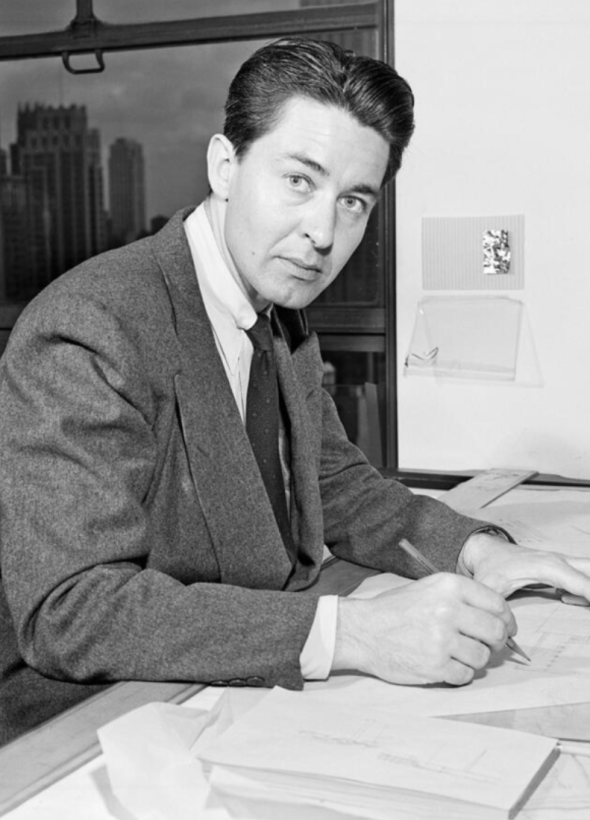
Maciej Nowicki - “The pioneer of the suspension roof”
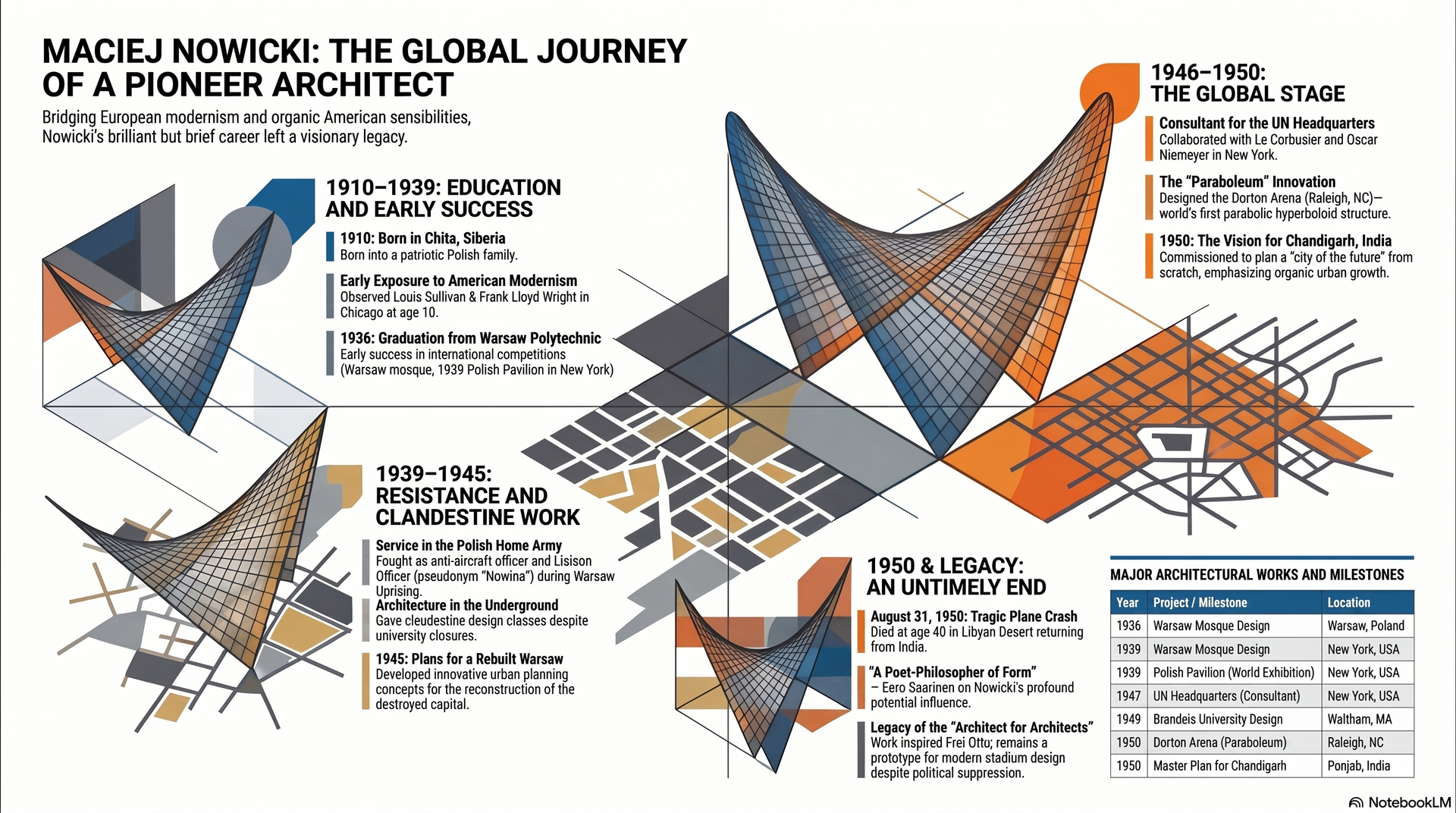
Maciej (Matthew) Nowicki was a visionary Polish architect and educator whose pioneering work profoundly influenced modern global architecture. Alongside his wife and collaborator Stanisława Sandecka-Nowicka , he contributed to the postwar reconstruction of Warsaw before immigrating to the United States due to political shifts. In the U.S., Nowicki served as a professor, helped design the United Nations Headquarters , and created groundbreaking structures like the Dorton Arena in Raleigh, North Carolina, which featured the world's first cable-supported roof system. His exceptional career was cut short by a tragic 1950 plane crash in the Libyan Desert while he was designing the new Indian capital of Chandigarh . Despite his untimely death, his humanist approach and structural innovations left an enduring legacy that is celebrated through biographical works and university archives.
Deliverables
Maciej Nowicki
Global Journey Architect
Cinematic Video
Cinematic Video for 8-years old
Maciej Nowicki and the First Suspension Roof English Podcast
Maciej Nowicki, architekt, który rzucił wyzwanie grawitacji Polish Podcast